
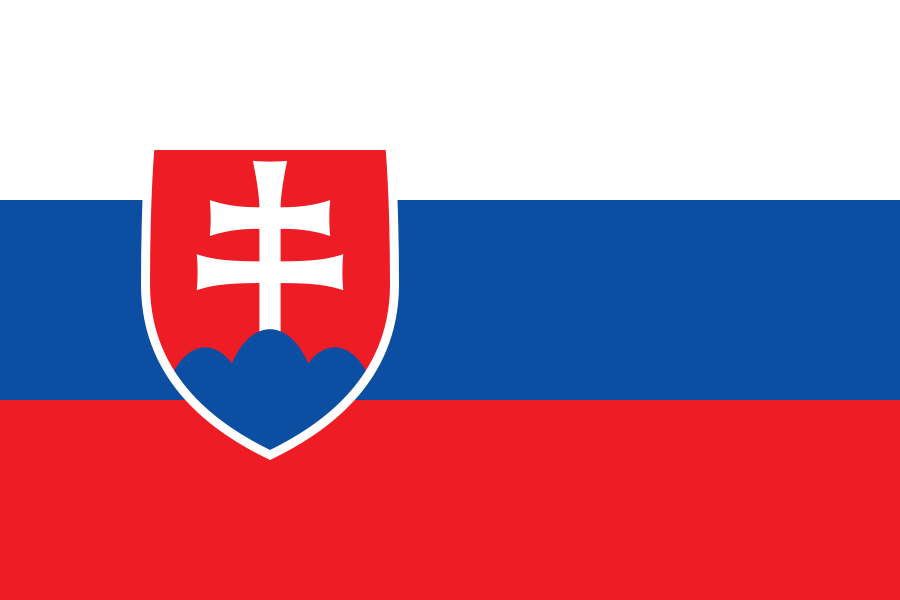
The best eSIM for Slovakia, compared for you: price, data, coverage and activation.
Compare eSIM plans for Slovakia: data, duration, prices and operators. Find the best offer and activate it now.
Each provider's best plan for this country, with the real price.
| Provider | Data | Duration | Price | Price/GB | |
|---|---|---|---|---|---|
 Saily ★ 4.7 · Review | 20 GB | 30 days | $37.10 | $1.86 | View → |
 Ubigi ★ 4.4 · Review | 20 GB | 30 days | $45.13 | $2.26 | View → |
 YesSim ★ 4.3 · Review | 10 GB | 30 days | $28.08 | $2.81 | View → |
 DrimSim ★ 4.1 · Review | 5 GB | 30 days | $15.70 | $3.14 | View → |
A comparison of the cheapest plans, all providers combined.
| Provider | Data | Duration | Price | Price/GB |
|---|---|---|---|---|
Saily | 1 GB | 7 days | $4.01 | $4.01 |
DrimSim | 1 GB | 7 days | $4.98 | $4.98 |
Ubigi | 500 MB | 30 days | $5.01 | $10.03 |
YesSim | 1 GB | 7 days | $6.02 | $6.02 |
Ubigi | 1 GB | 30 days | $7.02 | $7.02 |
Saily | 3 GB | 15 days | $9.03 | $3.01 |
Finding the best Slovakia eSIM plan is not just about choosing the largest data allowance. You also need to check which network is actually used, the validity period, the countries included in your itinerary and the settings that help you avoid unpleasant surprises on arrival. This guide helps you choose, install and use your eSIM with peace of mind, from Bratislava to the High Tatras.
An eSIM is a digital SIM card built into your phone that downloads a carrier profile instead of requiring a small plastic card. After purchasing a plan, you will usually receive a QR code, an installation link or a manual code. Your phone then saves a data profile and connects, once in Slovakia, to the partner network selected by the provider.
Compared with a physical SIM, an eSIM means you do not have to remove your regular card, look for a shop in Bratislava or risk losing your French number. On a Dual SIM-compatible device, you can keep your main line for calls and SMS while assigning mobile data to your travel eSIM. This is the most convenient option for using Google Maps, public transport, bookings and messaging apps without activating the expensive data of your regular line.
You can purchase and install your eSIM before departure, ideally using your home or hotel Wi-Fi the day before travelling. However, be aware that installing does not always mean activating. Depending on the plan, validity may begin either when you install it or when the eSIM first connects to a Slovak network. Read this rule before scanning the QR code, especially if you are buying a short 7-day plan.
The best eSIM for Slovakia is the one that relies on a good local partner and matches your itinerary—not necessarily the one offering the most data. The country’s three major mobile networks are Orange Slovensko, Slovak Telekom and O2 Slovakia. Travel eSIMs connect to one of them, sometimes through automatic selection and sometimes with several networks available depending on the commercial agreement.
In Bratislava, Košice, Žilina, Nitra, Banská Bystrica and Prešov, a 4G connection is normally very reliable, and 5G is available in many urban areas. For checking maps, making video calls or working on the go, 4G is more than sufficient; 5G mainly provides extra convenience for downloads and in busy places. In favourable conditions, speeds can range from a few dozen to several hundred Mbps, but these figures should not be considered guaranteed.
The situation changes in valleys, forests and mountain ranges. In the High Tatras, the Low Tatras National Park, Slovenský raj or certain areas near the Ukrainian, Polish and Hungarian borders, the terrain can block the signal. You will often have 4G in villages, resorts and car parks, followed by less consistent coverage on trails. An eSIM cannot compensate for an area without a mast, so download your maps and routes for offline use before setting out on a hike.
The displayed network also depends on your phone, the weather, altitude, indoor conditions and local congestion. On a train between Bratislava and Košice, for example, the connection may alternate between very good and temporarily weak. Choose a plan that allows manual network selection if you will be travelling extensively outside cities: this may let you switch to a partner with better reception in a particular location.
A Slovakia-only eSIM is generally the simplest choice if you are staying in the country and looking for the best value for money. It covers your trip to Bratislava, the castles, spa towns and the Tatras without making you pay for coverage you do not need. However, check that it really is a national plan rather than a Europe plan with a different allowance depending on the country.
A regional plan becomes more suitable if your trip crosses borders. Vienna is very close to Bratislava, and many itineraries combine Slovakia with Austria, Hungary, Czechia or Poland. A Europe eSIM means you do not have to change profiles when crossing the border and gives you data as soon as you arrive in the next country.
The downside is that a multi-country plan may cost more per gigabyte or offer different partner coverage from a local eSIM. Most importantly, examine the exact list of countries, since “Europe” does not always include every territory in the same way. If you leave the European Union, for example to Serbia or Ukraine, never assume that your European plan will continue to work.
Traveller feedback is generally positive when the eSIM is installed before departure and the plan genuinely matches the intended usage. Immediate connectivity on arrival in Bratislava, no need to find a shop and the ability to keep your main number are the benefits mentioned most often. For a city break, this simplicity is often more valuable than a small price difference.
The reported difficulties are less related to eSIM technology itself than to overlooked details: a locked phone, the wrong line selected for data, eSIM roaming left disabled or a QR code that has already been used. Travellers heading out on hikes sometimes regret expecting perfect coverage in valleys and on trails, even though the Slovak terrain naturally limits mobile networks.
The best indicator of reliability remains provider transparency: the advertised partner network, validity rules, tethering policy, top-up procedure and accessible support. Be wary of vague “unlimited” data promises without an explanation of the fair usage policy, which may significantly reduce speeds after a certain amount of data.
The safest approach is to purchase and install it over stable Wi-Fi before departure, then activate travel data once you arrive in Slovakia.
Check that your device supports eSIM and is unlocked. Also make sure you have a Wi-Fi connection, enough battery and no unnecessary eSIM profiles taking up space on your phone; some devices limit the number of saved profiles.
Choose a plan whose validity covers your entire stay, then keep the QR code, SM-DP+ address and activation code somewhere accessible offline. Never share this QR code: it can often be used only once. Above all, read the rule stating whether the countdown begins upon installation or at the first local connection.
On iPhone, go to Settings > Cellular/Mobile Data > Add eSIM, then select “Use QR Code”. On Android, the path varies: generally look for Settings > Connections/Network & Internet > SIM Manager > Add eSIM, or the equivalent option on your Samsung, Pixel or other device. Name the line “Slovakia” to avoid confusion with your regular SIM.
Once in Slovakia, activate the eSIM line, choose it as the mobile data line and allow data roaming on this eSIM if the instructions require it. Disable data on your French SIM. The APN is often automatic; if it is not, enter exactly the one provided, without adding spaces or changing unnecessary fields.
Turn airplane mode on and off for about thirty seconds, restart the phone and check that the eSIM is the active data line. Then check roaming, the APN and network selection; wait a few minutes after arrival. Do not delete the profile too quickly: contact support with screenshots of the settings and the error message.
Yes, you can keep your usual number while using a travel eSIM for internet, provided you assign the right role to each line. Most tourist eSIMs are data-only: they provide mobile data but no Slovak number, traditional calls or SMS. Your main SIM therefore remains useful for receiving bank SMS messages or important calls, while the eSIM handles Maps, searches and apps.
On both iPhone and Android, set your Slovakia eSIM as the default data line and disable the option that allows the phone to switch automatically to the other line for data. You can leave your French SIM active to receive SMS, but disable its data roaming. Keep in mind that answering a traditional call or making a call from this line may be charged according to your French plan.
WhatsApp, Signal, Telegram, FaceTime Audio, Messenger and VoIP calls continue to work with your usual number as long as you have internet access. You do not need to change your WhatsApp number after installing the eSIM. For SMS verification codes, simply keep your main line active; if your carrier charges for receiving SMS abroad, check its terms before departure.
Tethering is very convenient for a laptop on a train or in a rental, but it is not automatically allowed on every plan. Check that hotspot use is permitted and monitor your consumption: a macOS update, photo synchronisation or video conference can use several gigabytes very quickly. If your plan runs out, purchase a compatible top-up or a new plan before cancelling the old one, since remaining data cannot always be transferred.
The right allowance depends on your habits: 1 to 3 GB is often enough for a few days of maps and messaging; 5 to 10 GB comfortably covers one to two weeks; above 20 GB, you are generally planning to work remotely, use tethering or watch videos frequently.
Yes, in principle, as soon as your phone picks up a partner network and the eSIM line is active. Complete the settings over Wi-Fi before departure, then activate data on arrival; network registration may take a few minutes.
It depends on the provider: the period begins either upon installation or when you first connect to a network in Slovakia. This information appears in the plan terms and should be checked before scanning the QR code.
No, an eSIM profile is normally intended for one device and cannot be freely transferred. Use your phone’s hotspot if permitted, or purchase a second plan for the tablet.
The European emergency number is 112. Local numbers also exist for the police, fire service and ambulance, but 112 is the simplest number to remember; do not rely on a data-only eSIM for traditional calls in every situation.
Terms vary: a profile that has already been installed or used is often non-refundable. Before requesting a refund, keep screenshots, check the APN and roaming settings, then contact support promptly without deleting the eSIM.
Compare the 18 eSIM plans available above and find the perfect offer for your stay in Slovakia.
See all plans







 Airalo
 Holafly
 Saily
Saily YesSim
 DrimSim
 Ubigi
Ubigi