
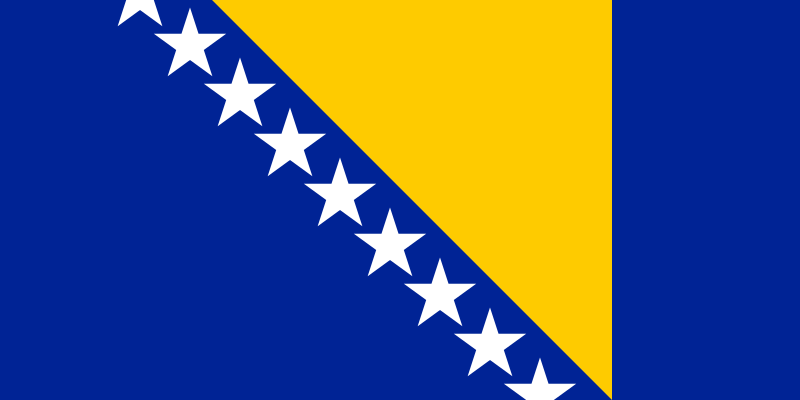
The best eSIM for Bosnia and Herzegovina, compared for you: price, data, coverage and activation.
Compare eSIM plans for Bosnia and Herzegovina: data, duration, prices and operators. Find the best offer and activate it now.
Each provider's best plan for this country, with the real price.
| Provider | Data | Duration | Price | Price/GB | |
|---|---|---|---|---|---|
 Saily ★ 4.7 · Review | 20 GB | 30 days | $37.10 | $1.86 | View → |
 Ubigi ★ 4.4 · Review | 20 GB | 30 days | $45.13 | $2.26 | View → |
 Holafly ★ 4.6 · Review | Unlimited | 5 days | $19.05 | — | View → |
 YesSim ★ 4.3 · Review | 10 GB | 30 days | $28.08 | $2.81 | View → |
 DrimSim ★ 4.1 · Review | 5 GB | 30 days | $15.70 | $3.14 | View → |
 Airalo ★ 3.9 · Review | Unlimited | 10 days | $47.13 | — | View → |
A comparison of the cheapest plans, all providers combined.
| Provider | Data | Duration | Price | Price/GB |
|---|---|---|---|---|
Airalo | 1 GB | 7 days | $4.01 | $4.01 |
Saily | 1 GB | 7 days | $4.01 | $4.01 |
DrimSim | 1 GB | 7 days | $4.98 | $4.98 |
Ubigi | 500 MB | 30 days | $5.01 | $10.03 |
YesSim | 1 GB | 7 days | $6.02 | $6.02 |
Airalo | 2 GB | 15 days | $6.52 | $3.26 |
Finding the best Bosnia and Herzegovina eSIM plan lets you get online as soon as you arrive, without paying often-expensive French roaming charges or looking for a shop. This guide helps you choose the right amount of data, check coverage along your itinerary and set up your eSIM without unpleasant surprises.
An eSIM is a digital SIM card built into your phone that downloads a mobile profile instead of requiring a plastic card. After purchasing a plan, the provider usually sends you a QR code, an installation link or activation through its app. You can purchase and install this profile from France over Wi-Fi, then use it for data only once you arrive in Bosnia and Herzegovina.
Unlike a physical SIM, an eSIM requires no tray to open, no card replacement and no search for a sales point at Sarajevo Airport. It contains the same type of network information as a conventional SIM: your device connects to a local partner, provides Internet access and uses the data included in your plan. A travel eSIM is usually data-only: it gives you access to the web, but not necessarily a new Bosnian number for standard calls.
On a recent phone, you can use the Dual SIM feature: your French card remains active for your usual number, while the eSIM handles mobile data while you travel. This is very convenient for keeping your WhatsApp conversations, receiving an SMS verification code or remaining reachable on your French line. However, making or receiving calls and SMS on your French SIM may trigger your operator’s roaming charges; the eSIM does not automatically prevent them.
The key point is that your device must be both eSIM-compatible and unlocked. A phone purchased from an operator is often unlocked nowadays, but this is not universal, particularly with certain older or business devices, or phones bought abroad. An eSIM will not work if the phone is locked to another network, even if the model technically has an eSIM chip.
The best Bosnia and Herzegovina eSIM is the one using a strong network along your route, not simply the one advertising the largest amount of data. The main local operators are BH Telecom, which has extensive coverage in the Federation of Bosnia and Herzegovina, m:tel, historically well established particularly in Republika Srpska, and HT Eronet, which is especially relevant in certain areas of Herzegovina. Travel eSIM providers use one or more of these partner networks.
In Sarajevo, Mostar, Banja Luka, Tuzla, Zenica, Bihać and around Međugorje, you will normally find reliable 4G for navigation, messaging, bookings and occasional video. 5G is developing and may be available locally depending on the network and eSIM offer, but it should not be your only criterion. A good, stable 4G connection is often more useful than an intermittent 5G logo, especially for using Google Maps, ordering a taxi or sending documents.
The country’s geography calls for some caution. Bosnia and Herzegovina is very mountainous, with valleys, tunnels and secondary roads throughout the country, so coverage can vary within just a few kilometres. Between Sarajevo and Mostar, the signal is generally adequate on major routes but may weaken in certain narrow sections. In isolated villages, natural parks, the mountain ranges near Bjelašnica, Jahorina or Sutjeska, or on some rural roads in the east, your phone may switch to 3G or even lose service.
Actual speeds depend on the antenna, time of day and congestion. In cities, a 4G connection usually supports video calls, photo sharing and reasonable streaming; in rural areas, prioritise reliability over speed. For a road trip, download offline maps and tickets before leaving a major city. Also check whether the plan clearly states its partner network or networks: an eSIM able to select several networks is a real advantage in hilly terrain.
A national eSIM is generally the best choice if your trip takes place entirely in Bosnia and Herzegovina, as it focuses your budget on one country and may offer more data for the same validity period. This is suitable for a stay in Sarajevo, a Mostar–Blagaj–Jajce loop or a holiday on the Neum coast. However, check that the plan covers the whole country rather than just an imprecisely defined area.
A Balkans or Southeastern Europe plan becomes more attractive as soon as you cross a border. Common itineraries combine Bosnia and Herzegovina with Croatia, Montenegro, Serbia, Slovenia, Albania or North Macedonia. A journey from Dubrovnik to Mostar and then to Kotor, for example, involves several country changes: a single regional eSIM avoids buying and reinstalling a profile at every stop.
Be especially careful at borders. Bosnia and Herzegovina is not part of the European Union, so the European principle of included roaming does not automatically apply to your French plan or to a plan marketed simply as European. Read the exact list of covered countries, the amount of data available in each and any regional roaming rules. A worldwide plan covers more destinations, but is often less competitive in price per gigabyte than a local or Balkans offer.
Traveller feedback is generally positive when the eSIM is installed before departure and the plan genuinely matches the itinerary. The most frequently mentioned advantage is being able to call accommodation, find an ATM, check a map or book transport as soon as you leave the plane, without looking for a shop or handling your main SIM card. The ability to monitor usage from an app is also appreciated.
Criticism mainly concerns unrealistic expectations. Some travellers expect 5G everywhere, while Bosnia’s terrain makes performance uneven outside cities. Others install their eSIM at the last minute without Wi-Fi, forget to enable data roaming on the eSIM line or leave their French card selected as the data line. These issues look like a breakdown but often result from a simple setting.
Support is an important criterion, especially if you arrive late in Sarajevo or travel without another connection. Choose a provider that clearly lists its partner networks, validity start date, top-up rules and an accessible contact method. A slightly cheaper offer can cost time and cause stress if its instructions are vague or tethering is restricted without being clearly stated.
Install your eSIM at home or somewhere with stable Wi-Fi, then activate its data when instructed by the provider. This avoids relying on airport connectivity to solve a configuration problem.
Start by confirming that your phone supports eSIM and is unlocked. Also check that an eSIM slot is available: some devices store several profiles but allow only two to be active at once. Update the system before departure; this can fix network-detection issues.
Choose a plan based on your trip length, usage and any border crossings. You will often receive a QR code by email, sometimes in the provider’s app. Keep an offline copy of the QR code and any APN address, but do not scan the code on the same phone without following the recommended method: open the email on a second screen or use manual installation.
On iPhone, go to Settings > Cellular > Add eSIM, then choose Use QR Code or Enter Details Manually. On Android, the path varies slightly: generally open Settings > Connections or Network & Internet > SIMs > Add eSIM. Give the line a clear name, such as Bosnia data, so you never confuse it with your French SIM.
After landing or crossing the border, select the eSIM as your mobile data line and enable data roaming only on that line. This roaming is necessary because many travel eSIMs operate through a local partner. The APN normally configures automatically; if Internet access does not start, copy the supplied APN exactly, without spaces or changes, into your mobile network settings.
Turn airplane mode on and off for about thirty seconds, or restart the phone to force network registration. Check that the French SIM has not remained the data line and that roaming is active on the correct eSIM. If necessary, temporarily select the partner network manually, reset only the network settings as a last resort and contact support with screenshots of your settings.
Yes, you can generally keep your French number while using a travel eSIM for Internet access thanks to Dual SIM mode. Set the eSIM as the mobile data line and leave your usual SIM active only if you need to receive SMS messages. Disable roaming data on the French line and, if your phone allows it, disable automatic cellular-data switching so it does not change lines when the signal varies.
Most travel eSIMs are data-only: they provide neither a Bosnian number nor standard calls or SMS. This does not prevent you from communicating. WhatsApp, Signal, Telegram, Messenger, FaceTime Audio, Skype and Wi-Fi calls work over data while keeping your current WhatsApp number. You do not need to create a new WhatsApp account: the app remains linked to your French number as long as you do not change it in the settings.
Tethering works with many eSIMs, but it is not universally guaranteed. Check this before buying if you need to connect a computer, tablet or someone else’s phone. A hotspot uses data very quickly: a professional video call, system update or computer streaming can consume in one hour what your phone alone would use over several days. Some plans may restrict this feature or limit speeds.
When your allowance is nearly empty, first use your hotel’s Wi-Fi to check the app and buy a top-up. Do not assume you can purchase exactly the same plan again: some providers offer a top-up, while others require a new plan or profile. Monitor both the phone’s counter and the provider’s counter, as they may show a slight difference. Once the allowance is used up, the connection is normally cut off rather than charged outside the plan, but confirm this in the terms.
For one week of navigation, messaging and maps, you will often need 3 to 5 GB; for two active weeks or regular social-media use, aim for 8 to 15 GB. Remote workers, content creators and anyone using a hotspot should plan for more and use Wi-Fi for demanding tasks.
Yes, in principle, if it is already installed and you enable mobile data and roaming on the eSIM line. At the airport, wait a few minutes after disabling airplane mode; restarting the phone often resolves the first connection.
It depends on the provider: validity begins either upon installation or upon the first connection to a covered network. Check this rule before buying, as installing a plan whose validity starts immediately may make you lose days.
No, an eSIM profile is normally intended for one device. To connect two phones, buy two plans or use tethering from the main phone if your offer allows it.
Do not rely on a data eSIM for standard emergency calls. In Bosnia and Herzegovina, 112 can be used as the general emergency number, but keep your main SIM active or ask people nearby for help if you have no voice network.
The rules vary by provider and often become restrictive after installation or the first data usage. Contact support immediately with screenshots, before buying a second plan, and keep your proof of purchase.
A VPN can improve your privacy on public Wi-Fi networks, but it is not essential on a mobile connection. It can also reduce speeds or complicate certain connections; temporarily disable it if your eSIM appears unable to access the Internet.
Compare the 45 eSIM plans available above and find the perfect offer for your stay in Bosnia and Herzegovina.
See all plans







 Airalo
 Holafly
 Saily
Saily YesSim
 DrimSim
 Ubigi
Ubigi